
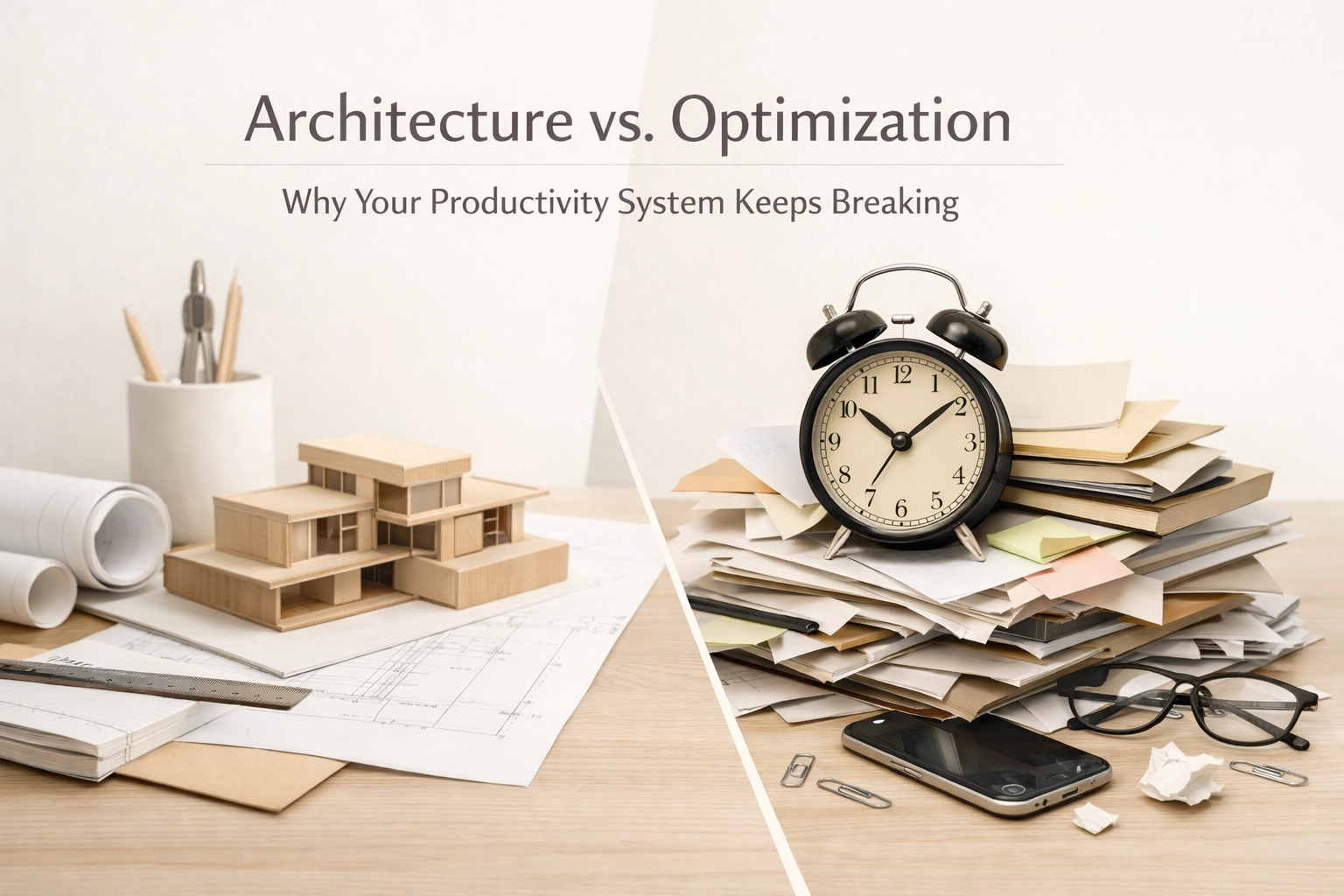
Architecture vs. Optimization: Why Your Productivity System Keeps Breaking
You possess high internal capacity. This is an observable fact, evidenced by the complexity of the life you currently manage. Yet, the systems you use to manage that life: the calendars, the apps, the "hacks," the meticulous morning routines: periodically collapse.
When these systems break, the common reaction is to optimize. You seek a faster workflow, a more robust task manager, or a more disciplined schedule. You assume the failure is a result of inefficiency.
This is not a failure of efficiency. It is a failure of architecture.
Optimization is the process of making a system more efficient. Architecture is the structural design that determines what the system is capable of holding. You are currently attempting to optimize a structure that was never designed to hold the weight of your current reality. You are trying to run a high-definition life on an outdated operating system.
Optimization is the Art of Doing the Wrong Things Faster
Optimization assumes the underlying foundation is sound. In the world of software development, if the architecture is flawed, no amount of code refinement will prevent a system crash when the user load increases. If you optimize a broken process, you simply reach the point of failure more quickly.
For the high-capacity woman, optimization often looks like "doing more." It looks like squeezing an extra thirty minutes out of a day through a bio-hack or a new time-blocking technique. It is a local refinement. It addresses the symptoms of friction without addressing the source of the heat.
Architecture is different. Architecture is the invisible blueprint that dictates how components interact. It is the life operating system that governs how you process information, make decisions, and exert authority.
When a productivity system breaks, it is rarely because you lacked the discipline to follow the steps. It is because the steps were built for a persona you have outgrown. You are executing scripts you did not author, using an infrastructure designed for a smaller version of your life.

The Fragility of Performance vs. Structural Integrity
Most productivity advice is focused on performance. Performance is a measure of output over a specific timeframe. Architecture is a measure of durability.
There is a critical threshold where optimization hits a ceiling. In engineering, a system might achieve a 2x performance increase through low-level tweaks. However, achieving a 10x increase: or maintaining stability during a 10x increase in complexity: requires a fundamental architectural redesign.
Your life has increased in complexity. Your responsibilities have scaled. Your internal world has deepened. If you are still using the same mental models and organizational structures you used five years ago, you are operating at an architectural deficit.
The breakage you experience: the burnout, the "invisible load," the feeling of over-functioning masquerading as strength: is the sound of a structure reaching its load-bearing limit. It is not an emotional crisis; it is a structural mismatch.
The Three Layers of Sovereign Architecture
To move from a fragile state of constant optimization to a stable personal operating system, you must address the three layers of internal authority: Identity, Ingenuity, and Creation.
1. The Identity Layer (The Source Code)
This is the foundational layer of your architecture. It is the "Who" behind the "How." Most productivity systems ignore identity entirely, treating the user as a generic unit of labor.
High-capacity women often operate from "inherited scripts": invisible systems of "should" and "must" that were authored by family, culture, or previous versions of themselves. When your daily actions (Creation) are in conflict with your internal truth (Identity), the friction creates a massive energy leak.
A sustainable productivity system begins with identity formation. It requires auditing the scripts you are currently executing and replacing them with a system you have consciously authored.
2. The Ingenuity Layer (The Decision Architecture)
Ingenuity is the layer of strategy and decision-making. It is how you translate identity into a plan of action.
If your decision-making process is reactive, you are not leading; you are responding. You are playing defense against your own inbox. Relational governance: the way you manage your boundaries and interactions with others: lives in this layer.
Architecture in this layer means building frameworks for decision-making that don't require you to start from scratch every time a request is made. It is moving from "What should I do?" to "What does the system dictate?"
3. The Creation Layer (The Execution Infrastructure)
This is where most people start and end. This is the realm of tasks, projects, and calendars.
In a sovereign architecture, the Creation layer is the least important because it is entirely dependent on the layers above it. If Identity and Ingenuity are aligned, execution becomes a matter of simple mechanics. If they are not, execution feels like pushing a boulder uphill.
A transferable system is one where the execution does not depend on your emotional state or a sudden burst of "motivation." It is a durable infrastructure that supports your work regardless of the external weather.

From Persona to Transferable System
Many successful women have built their lives on the strength of their "persona." You are the one who gets it done. You are the one who remembers every detail. You are the one who carries the invisible load.
This is not a system; it is a performance. It is unsustainable because it requires your constant, active presence and high-octane energy to maintain.
The shift to HER Sovereign OS is the shift from being the system to having a system.
A transferable system is an architecture that can hold the complexity of your life without requiring you to "over-function" to keep it from collapsing. It is the difference between being the engine and being the architect of the engine.
When you move from optimization to architecture, you stop trying to fix the "you" that is struggling. Instead, you begin to observe the structural gaps that are creating the struggle. You stop asking "What is wrong with me?" and start asking "Where is the system failing to support my capacity?"
The Cost of Architectural Neglect
The cost of staying in the "optimization" loop is not just fatigue. It is fragmentation.
Fragmentation occurs when your energy is split across too many competing scripts. You are one person in your business, another in your relationships, and a third in your private internal world. This lack of coherence is the primary drain on high-capacity women.
An integrated architecture creates coherence. It allows the same core principles to govern your business, your health, and your household. This is relational governance in its highest form: a singular life operating system that scales with you.

This is Not a Journey; It is Infrastructure
We do not speak of this work in terms of "transformation" or "healing." Those are emotional metrics. We speak in terms of integration and structural integrity.
You do not need a new "hack." You do not need to be more disciplined. You do not need to "optimize" your way out of a structure that is too small for your soul.
You need a new architecture.
The work of HER Sovereign OS is the work of building that architecture. It is the process of identifying the scripts you didn't write, dismantling the systems that no longer serve your capacity, and installing a sovereign operating system that is authored by you, for you.
This is not about doing more. It is about building a structure that allows you to be more, with less friction. It is the shift from the exhaustion of constant optimization to the calm of a durable architecture.
If you are ready to stop optimizing the wrong things and start building the right system, you are in the right place. The architecture of your internal authority is waiting to be authored.

Architecture is not a luxury. For the high-capacity woman, it is the only way to remain sustainable. It is the difference between a life of performance and a life of sovereignty.
Stop fixing the symptoms. Address the system.
The complexity of your life is not a problem to be solved; it is a reality to be architected. It is time to move beyond the breaking point and into a system designed for the weight of your genius.