
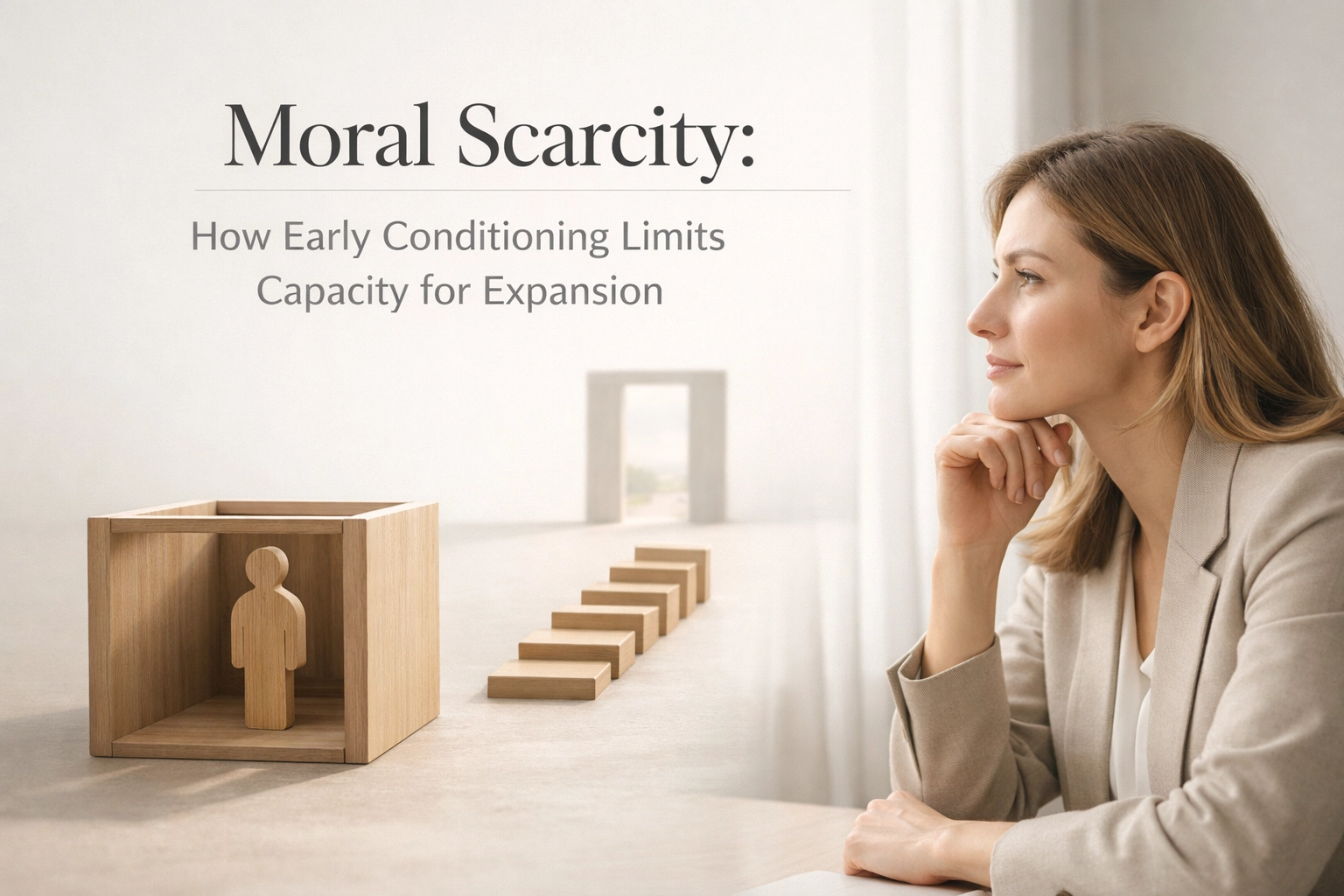
Moral Scarcity: How Early Conditioning Limits Capacity for Expansion
Growth is not an external achievement. It is a structural capacity. For many high-capacity women operating at the intersection of leadership and entrepreneurship, the barrier to the next level of expansion is rarely a lack of skill, strategy, or market opportunity. It is a structural limit within the internal architecture. This limit is the Moral Scarcity constraint.
Moral Scarcity is a systemic protocol that views abundance: whether in the form of capital, influence, or visibility: as a direct threat to moral integrity. It is an inherited belief system that identifies expansion as a moral risk. When the internal system encounters a growth threshold, it does not evaluate the opportunity based on ROI or logic. It evaluates the opportunity against a source code that equates "enough" with "good" and "more" with "dangerous."
The Invisible Governor of the Internal Architecture
In engineering, a governor is a device used to measure and regulate the speed of a machine. It ensures the system does not exceed safe operating parameters. Moral Scarcity functions as an invisible governor within the identity architecture of the high-achieving woman.
This constraint is not a character flaw. It is a security feature installed during early faith formation and socialization. It was designed to keep the individual within the boundaries of a specific community or moral framework. However, as the woman-owned business scales, this governor begins to create friction. The system attempts to expand, but the source code triggers a shutdown sequence to prevent what it perceives as moral compromise.
This is why you experience a ceiling. It is not because you lack the intelligence to navigate the next level. It is because your internal architecture is programmed to believe that reaching the next level will cost you your goodness.

The Source Code of Permissibility
Every internal system operates according to a permissibility protocol. This protocol determines which actions are integrated into the identity and which are rejected as "not me." For many, this protocol was written in environments where scarcity was spiritualized.
Belief formation psychology suggests that early conditioning creates a foundational layer of "truth" that the conscious mind rarely questions. If the early environment taught that "it is easier for a camel to go through the eye of a needle than for a rich man to enter the kingdom of God," the system creates a hard link between financial expansion and spiritual exclusion. This is the source code of Moral Scarcity.
In this framework, poverty or "just enough" is a sign of virtue. Wealth and power are signs of corruption. When a leader attempts to scale a business, she is not just fighting market forces; she is fighting a source code that views her success as a moral failure. To the internal system, staying small is staying safe. Expanding is an act of deviance.
Diagnostic: Identifying the Moral Risk Alert
Identifying the presence of Moral Scarcity requires a clinical audit of business outcomes and internal friction points. This is not about analyzing feelings; it is about documenting patterns of structural limitation.
The Moral Scarcity constraint typically manifests through three specific diagnostic markers:
- Revenue Capping: The system consistently plateaus at a specific financial marker. This is not due to a lack of leads or sales skill, but a subconscious rejection of "excess" capital. The leader may find herself suddenly increasing expenses or neglecting high-value opportunities once a certain threshold is reached.
- The Visibility Tax: Expansion requires visibility. If the inherited belief system equates visibility with pride or vanity, the system will generate "technical difficulties" or procrastination around marketing and public positioning. Invisibility is maintained to protect the moral status of being "humble."
- Authority Deflection: The leader refuses to claim internal authority, instead deferring to "experts" or external consensus. This is a strategy to avoid the moral responsibility that comes with power. By remaining a "helper" or a "facilitator," she avoids the perceived moral risk of being a "ruler."
This is not self-sabotage. It is system coherence. The architecture is simply doing exactly what it was programmed to do: maintain moral safety at all costs.

The Myth of the Finite Pie
At the core of Moral Scarcity is the assumption of a finite pie. This is the belief that for one person to have more, another must have less. When applied to moral standing, this belief creates a zero-sum game of virtue.
In a woman-owned business, this often looks like a hesitation to charge premium rates or a guilt associated with high profit margins. The internal logic suggests that taking "too much" profit is an act of theft from the collective. This is a structural misunderstanding of value creation.
Moral Scarcity ignores the reality that expansion increases capacity for impact. It views the resource as the end, rather than the fuel for the infrastructure. To move past this, the architecture must be recalibrated to recognize that "more" is not a moral subtraction, but a functional addition.
Identity Architecture vs. Inherited Belief Systems
The work of expansion is the work of shifting from an inherited belief system to a constructed identity architecture. Most leaders are operating on a "default" settings profile. They are using the moral values, faith frameworks, and social expectations that were handed to them before they had the capacity to evaluate them.
True expansion requires an audit of these systems. It is the process of identifying which protocols are useful and which are legacy code that no longer serves the current mission. This is not an emotional journey; it is a structural renovation.
It is not about "unlearning" in a vacuum. It is about the intentional installation of a new permissibility protocol. This new protocol must be rooted in internal authority rather than external validation. It must define "goodness" not by lack or invisibility, but by coherence and capacity.

Recalibrating for Capacity
Recalibration is a technical process. It begins with the acknowledgment that the ceiling you are hitting is internal, not external. Once the constraint is identified as a Moral Scarcity protocol, the system can be updated.
This involves a three-step integration process:
- Isolation: Identifying the specific belief (e.g., "Power makes you a bad person") and isolating it from the functional identity of the leader.
- Evaluation: Examining the origin of the code. Was this installed by a specific religious framework? A family dynamic? A cultural distortion? Recognizing the source allows the leader to see the code as an external artifact rather than an absolute truth.
- Overwriting: Replacing the scarcity protocol with a capacity protocol. This looks like redefining power as "the ability to produce a desired effect" and wealth as "stored capacity for future action."
When the source code is updated, the friction disappears. The system no longer needs to generate anxiety or procrastination to prevent growth. Expansion becomes the natural, frictionless result of a clean architecture.
The Shift to Internal Authority
The ultimate resolution of Moral Scarcity is the shift to internal authority. In the old system, "moral safety" was defined by staying within the lines drawn by others. In the new architecture, moral integrity is defined by the coherence of the individual’s own systems.
When a high-capacity woman operates from internal authority, she no longer asks for permission to expand. She does not wonder if she is "allowed" to make ten million dollars or lead a global movement. She simply evaluates the structural requirements of her vision and builds the necessary infrastructure to support it.
The moral risk is no longer in having "too much." The moral risk is in having the capacity to lead and refusing to build the structure to hold it.

The Integration of Abundance
Expansion is not a departure from your values. It is the full expression of them. If your architecture is limited by Moral Scarcity, your impact will always be capped by your fear of being "too much."
Recalibrating your faith and identity architecture is the highest leverage work you can do. It removes the governor from the engine. It clears the path for a level of visibility, wealth, and power that was previously flagged as a risk.
This is the transition from a person who is "good" because they are limited, to a person who is powerful because they are integrated. The ceiling is not the sky. The ceiling is a line of code. Rewrite it.