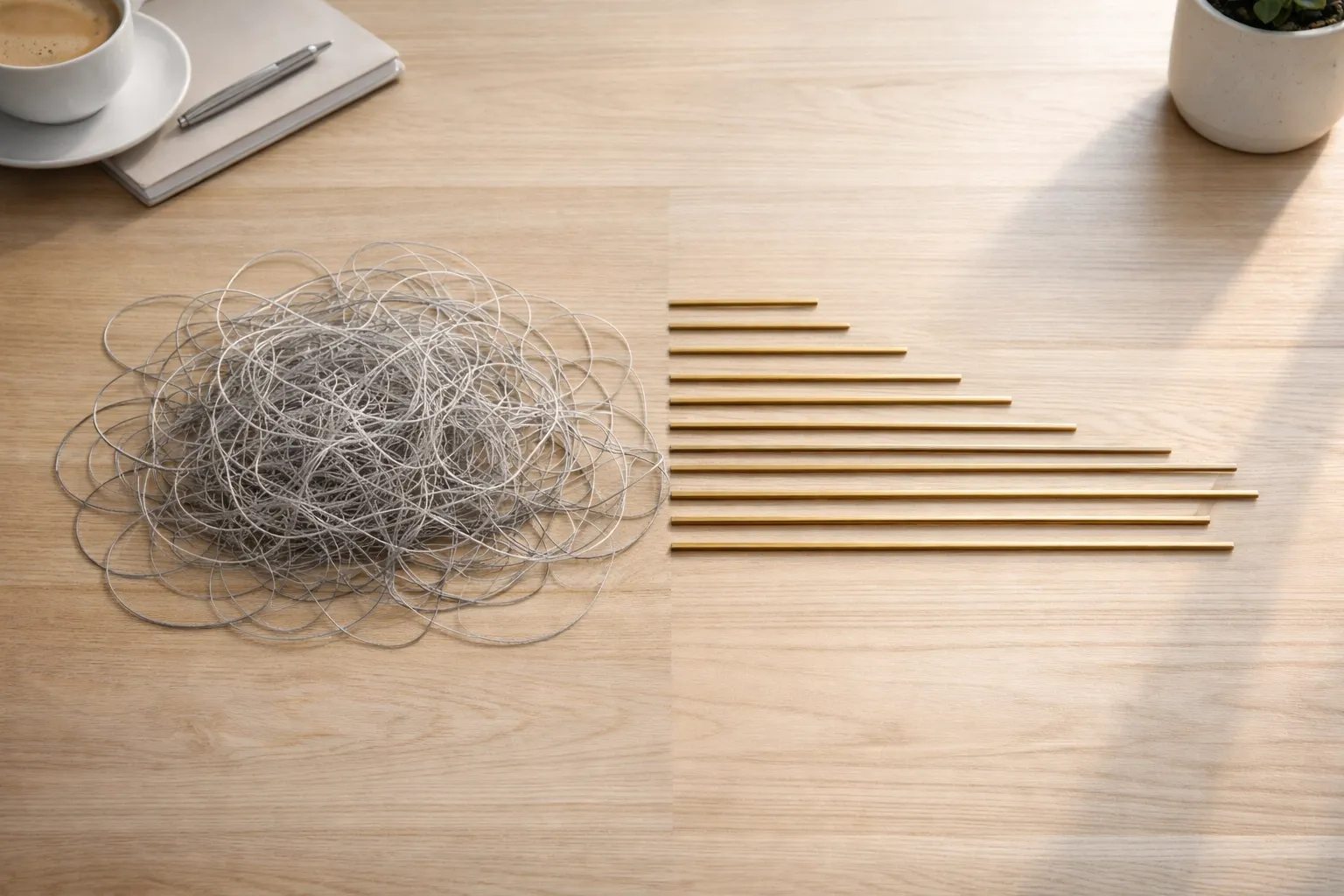
Success is often measured by what you can hold. For the high-capacity woman, this capacity is not merely a skill; it is the structural backbone of her entire world. You have spent years, perhaps decades, functioning as the primary stabilizer for your family, your business, and your community. You are the one who notices the gaps, anticipates the friction, and quietly resolves the tension before it destabilizes the system.
From the outside, this looks like mastery. Internally, it feels like a slow, invisible erosion.
This is not a failure of time management or a need for better boundaries. It is a structural consequence of an identity organized around being necessary. When your value is fused with your ability to stabilize others, you don’t just carry the load: you become the load-bearing wall.
The cost of this architecture is rarely financial or visible. It is the quiet, persistent feeling of being unfulfilled despite having achieved everything you set out to build. It is the realization that while your life works for everyone else, it has stopped working for you.
The Stabilizer Pattern™: How Competence Becomes a Cage
The Stabilizer Pattern™ is a survival adaptation that has successfully masqueraded as a leadership style. It begins early: competence invites responsibility, responsibility creates reliance, and over time, that reliance quietly reshapes your identity. You become the person who can handle it. Because you can handle it, you are given more. Because you are given more, you become indispensable.
Eventually, the system you built: the one that was supposed to provide freedom: becomes a cage.
This pattern is not a personality trait. It is a Stabilizer Pattern™ architecture that rewards you for disappearing. When you are the one who holds everything together, you are praised for your strength, your resilience, and your reliability. But that praise is contingent on your continued over-functioning. If you stop smoothing the edges, the system feels the friction. Because you have a high capacity for responsibility, you interpret that friction as your personal failure rather than a structural imbalance.
This creates a cycle where your strength is actually your ceiling. You cannot expand into new levels of leadership or self-authorship because your current capacity is entirely consumed by the maintenance of your existing environment.
The Architecture of Exhaustion
High-functioning women often experience a specific type of fatigue that rest cannot fix. This is not the fatigue of doing too much; it is the fatigue of being too much to too many. It is the result of Responsibility Asymmetry™: the invisible labor of tracking, anticipating, and absorbing the emotional and logistical needs of every environment you enter.
You are functioning as the emotional infrastructure. You track the moods of your team. You manage the logistical flow of your household. You anticipate the needs of your partner. You are the one who remembers what everyone else is allowed to forget.
This creates a state of chronic hyper-vigilance. Even when you are physically resting, your nervous system is still “online,” scanning for potential instability. You are never truly off-duty because the role of the Stabilizer is not a job description; it is a way of being. This is the Identity Misalignment that leads to internal exhaustion. You are living a life that is highly functional but internally fragmented.
The Myth of the Low-Maintenance Woman
Many successful women take pride in being “low maintenance.” In a world that demands much, being the woman who needs nothing feels like a badge of honor. It is the ultimate expression of the Stabilizer Pattern™: the ability to provide total support while requiring none in return.
However, being low maintenance is simply a sophisticated form of self-abandonment. It is a structural decision to assign your capacity to everyone else’s needs while leaving zero capacity for your own. When you are low maintenance for others, you are often high maintenance for yourself. You are the one who has to negotiate with your own exhaustion. You are the one who has to suppress your own desires to keep the peace.
This creates a profound identity dissonance. You have built a life that functions perfectly because you have removed yourself as a variable. You are the architect who forgot to include a room for herself in the design.
The S.O.S. Methodology: Moving Toward Sovereignty
Reclaiming your identity from the role of the Stabilizer requires more than mindset shifts; it requires a reconstruction of your internal governance. At Melissa McCrery, we use the S.O.S. framework (SEE-OWN-SOVEREIGN) to move women from being “required” to being self-led.
1. SEE: Structural Visibility
The first step is not to change what you are doing, but to see the architecture behind it. You must recognize the Stabilizer Pattern™ as it operates in real-time. This means naming the moments you step in to solve a problem that isn’t yours, or the moments you suppress your own voice to maintain environmental harmony. Until the system becomes visible, you cannot choose a different way of functioning.
2. OWN: Internal Authority
Once you see the pattern, you must own your role in maintaining it. This is not about blame; it is about reclaiming agency. You have been the stabilizer because it felt safe, because it felt virtuous, or because you didn’t know there was another way. Owning your authority means recognizing that How Identity Shapes Leadership is the foundation for all external results. You are the one who has assigned your capacity to these roles, and you are the one who can reassign it.
3. SOVEREIGN: Durable Governance
Sovereignty is the state of being internally governed. It is moving from a life where you are the backbone for everyone else to a life where you are the author of your own experience. A sovereign woman can still lead, still care, and still build: but she does so from a place of conscious choice rather than unconscious obligation. She has built an internal operating system that supports her expansion without requiring her collapse.
The Cost of Silence
The invisible cost of holding everything together is ultimately the loss of yourself. If you continue to prioritize the stability of the system over the integrity of your identity, you will eventually reach a point of fragmentation. You will have the life you wanted, but you will not be there to enjoy it.
The work of identity reconstruction is not about becoming less capable. It is about becoming more sovereign. It is about ensuring that your capacity is being directed toward what you are building, not just what you are maintaining.
If you recognize yourself in this pattern, it is time to look beneath the performance. Your strength was never meant to be your cage. It was meant to be the foundation for your sovereignty.
Are you ready to see the architecture of your own over-functioning?
The first step in disentangling your identity from the role of the Stabilizer is understanding exactly how the pattern is operating in your life.
-
Take the first step toward visibility: Complete the Stabilizer Assessment™ to identify your specific version of this pattern and what it is costing you.
-
Deepen your understanding: Order the ebook, The Invisible Cost, and begin the process of separating who you are from the roles you learned to perform.