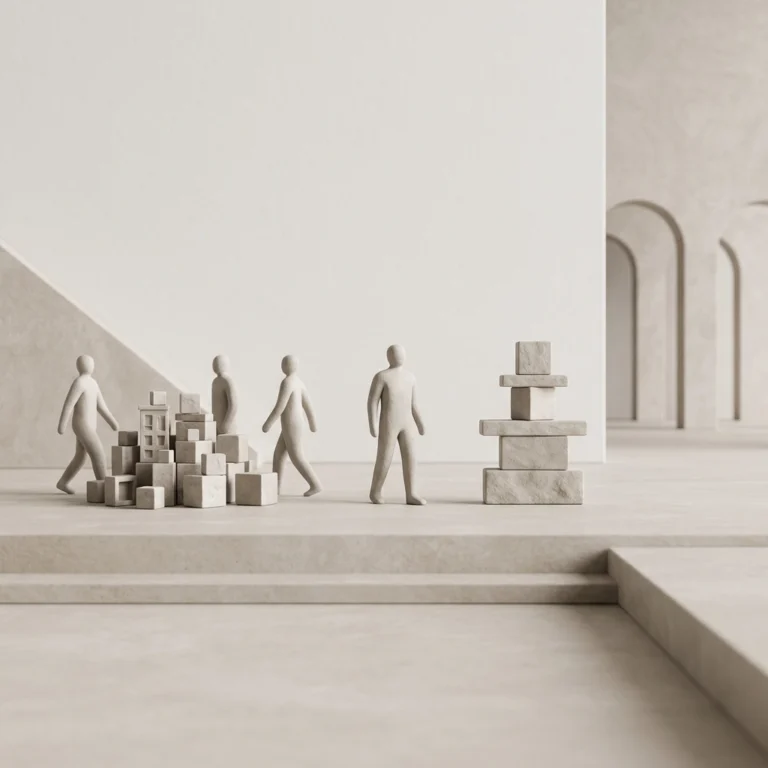

The Mechanics of Choice: Building a Durable Decision Architecture
Your current exhaustion is not a symptom of low willpower. It is a diagnostic indicator of structural failure within your decision-making engine.
For high-capacity women, the primary source of friction is rarely the inability to execute. You possess the competency to perform at scale. The friction emerges from a decision-making model that relies on reactive processing rather than a pre-built architecture. When every request, opportunity, and conflict requires a fresh internal negotiation, you are not leading; you are merely responding to external stimuli.
This is not a failure of character. It is an architectural deficiency.
The Reactive Response vs. The Sovereign Architecture
Most individuals operate within a reactive decision-making loop. In this model, the environment provides an input, a client request, a family need, a professional opportunity, and the individual processes that input through an emotional or pressurized filter. The goal of this processing is usually conflict resolution or the maintenance of external approval.
This is not choice. It is a reflexive reaction to external pressure.
A Durable Decision Architecture is a pre-calculated logic system. It acts as a filter that intercepts inputs before they reach the execution layer of your life. Instead of asking, "Should I do this?" you ask, "Does this input pass through the established logic gates of my current architecture?"
The shift from reactive to architectural is the shift from exhaustion to authority.
The Mechanics of Logic Gates
In computing, a logic gate is a device that performs a logical operation on one or more binary inputs and produces a single binary output. Your internal authority requires a similar level of technical precision.
When your decision architecture is robust, it functions as a series of logic gates based on your core identity and pre-determined commitments. If an input does not align with the established parameters of your HER Sovereign OS, the system returns a negative value. The decision is made before the emotional labor of "choosing" ever begins.

The Sequence of Processing
- Input Identification: Recognizing the external pressure or opportunity.
- Architectural Filtering: Passing the input through your defined governance system.
- Validation: Checking for alignment with long-term identity and capacity.
- Execution: Moving the verified input into the action layer.
When you lack this sequencing, inputs move directly to the execution layer. This causes systemic overload. You begin to execute on tasks and commitments that were never vetted for alignment. This is how high-capacity women find themselves successful in roles and lives that feel entirely alien to their true identity.
Decision Fatigue as Systemic Overload
Decision fatigue is often framed as a lack of mental stamina. This is incorrect. Decision fatigue is the predictable outcome of an unregulated decision-making process.
If every choice, from the strategic direction of your firm to the management of your household, requires a unique act of will, you are depleting your cognitive reserves on maintenance. A leadership operating system is designed to automate alignment so that your energy is reserved for high-level innovation and presence.
A Sovereign Decision Architecture reduces the number of active decisions you must make daily. By establishing high-level governance rules, you automate the "small" choices that typically bleed energy.
This is not about being rigid. This is about being structured.

The Internal Governance System
Your internal authority is the governing body of your life. In many high-capacity women, this governing body has been outsourced to external stakeholders: clients, family, societal expectations, or inherited moral frameworks.
Building a durable architecture requires reclaiming this governance. It involves defining the "Constitution" of your personal and professional life. These are the non-negotiable parameters that dictate how your time, energy, and intellect are deployed.
- Internal Authority is not permission. It is the recognition that you are the primary architect of your reality.
- Internal Authority is not defiance. It is the calm application of your own logic system over external demands.
When you operate from a Sovereign OS, you are no longer seeking permission to say no. You are simply reporting the output of your internal logic gates.
Sequencing vs. Prioritizing
Most time-management frameworks focus on prioritizing. This is a flawed approach because it assumes all inputs are valid and merely need to be ordered.
Architecture focuses on sequencing and exclusion.
It is not about doing the most important things first; it is about only doing the things that are architecturally sound. If a project or commitment does not fit the structural integrity of your current build, it is excluded. It does not matter how "good" the opportunity is. If it does not align with the foundational pillars of your identity formation, it is noise.
A durable architecture allows for a "sequence of one." You focus on the singular path that maintains the coherence of your system.

The Architecture of Refusal
One of the most critical components of a leadership operating system is the architecture of refusal. In a reactive model, refusal (saying "no") is an emotional event. It often carries guilt, hesitation, or the need for justification.
In a structural model, refusal is a technical necessity.
If you try to add a fifth floor to a building designed for three, the building will collapse. Refusal is not a personal rejection of the person asking; it is a structural protection of the system you are building. When your architecture is clear, refusal becomes a neutral act. It is simply an acknowledgment of capacity and alignment.
"This does not fit my current architecture" is a complete and professional diagnostic statement.
Moving Toward the HER Sovereign OS
Transitioning to a Sovereign Decision Architecture requires a period of systemic recalibration. You must audit your current decision-making patterns to identify where the "logic gates" are broken or non-existent.
This process involves:
- Identifying Leakage: Where are external inputs bypassing your internal filters?
- Defining Parameters: What are the absolute constraints of your current capacity and identity?
- Building the Gates: Creating the pre-calculated responses that protect your resources.
- Integration: Embedding these logic gates into your daily execution layer.
This is not a quick fix. It is the construction of a permanent infrastructure. A durable architecture is built to last for years, providing a stable foundation from which you can expand your influence without compromising your integrity.
The Goal: Automated Alignment
The ultimate aim of the Mechanics of Choice is to reach a state of automated alignment. This is a condition where your external actions are a perfect reflection of your internal authority, achieved with minimal friction.
You are not constantly fighting yourself. You are not debating your worth or your right to set boundaries. You are simply operating within a system that you designed, governed by logic that you established.
This is the hallmark of a sovereign leader. They do not have more time than you; they have better architecture. They do not have more willpower; they have more effective logic gates.
The complexity of your life will not decrease. Therefore, the sophistication of your decision architecture must increase. It is the only way to maintain coherence in an increasingly fragmented world.
It is time to stop choosing and start building.