
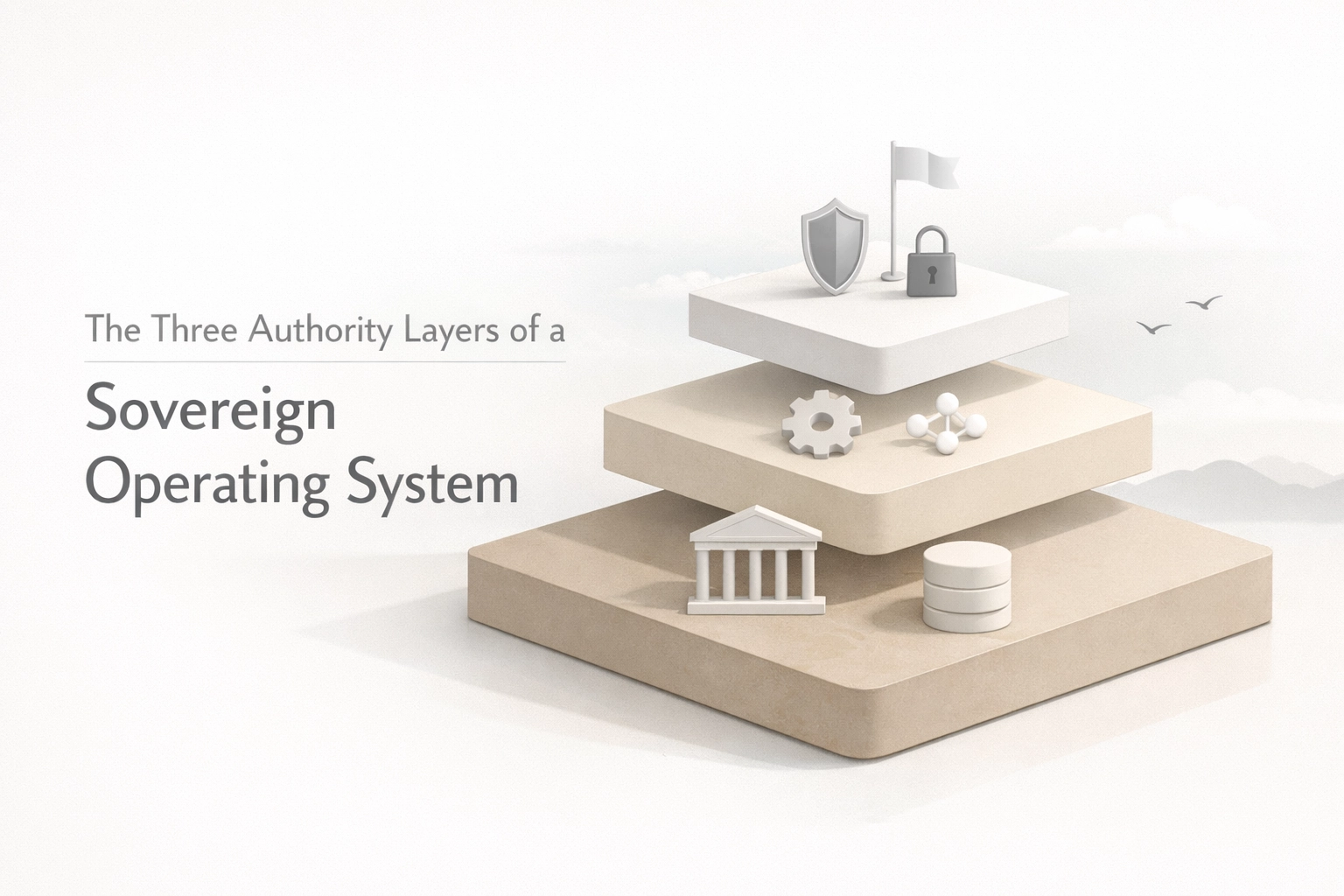
The Three Authority Layers of a Sovereign Operating System
Efficiency is not sovereignty. Most high-capacity individuals operate on an optimization model rather than an architectural one. Optimization seeks to improve the performance of an existing container; sovereignty seeks to define the container itself. When a system is built for optimization, it remains tethered to external benchmarks, metrics, and scripts. When a system is built for sovereignty, it functions through three distinct, integrated authority layers: Identity, Ingenuity, and Creation.
This is the structural difference between a life that is well-managed and a life that is sovereign. A well-managed life is a high-functioning response to external demands. A sovereign life is an internal projection of integrated authority. To transition from one to the other requires more than a shift in mindset. It requires a complete re-architecture of your self-management system.
The HER Sovereign Operating System (OS) is not a productivity tool. It is a structural framework designed to centralize authority within the individual across three critical domains.
1. Identity Authority: The Governing Kernel
Identity Authority is the foundational layer of the Sovereign OS. It is the root directory from which all other commands originate. In a fragmented system, Identity Authority is often outsourced to social scripts, professional expectations, or historical conditioning. When this layer is outsourced, the individual becomes an efficient executor of a life they did not design.
Identity Authority is not about "finding yourself" or seeking emotional clarity. It is a technical determination of internal standards. It is the layer where you define the governing principles of your existence. This layer determines what is "in scope" and what is "out of scope" for your energy and attention.
The Mechanics of Internal Standards
Most people operate on "comparative standards": they look at what peers are doing, what the market demands, or what the family system expects, and they calibrate their efforts to exceed those markers. This is a reactive state.
Identity Authority replaces comparative standards with structural standards. These are non-negotiable parameters that govern how you engage with the world. If your Identity Authority dictates that "Deep Focus" is a primary value, then any request that disrupts that focus is automatically rejected by the system logic. There is no emotional labor involved in the refusal because the refusal is a systemic requirement, not a personal preference.

The Cost of Identity Fragmentation
When Identity Authority is weak, the system suffers from "Identity Fragmentation." You may find yourself performing different roles for different audiences, leading to high cognitive load and a sense of internal friction. You are managing multiple versions of a "Good Woman" or a "Successful Professional" script. Sovereignty requires the consolidation of these fragments into a single, centralized Identity Authority.
2. Ingenuity Authority: The Architecture Layer
If Identity Authority determines the "Why" and the "What," Ingenuity Authority determines the "How." This is the layer of strategy, design, and architecture. In traditional productivity models, the "How" is often dictated by "Best Practices": external methodologies that promise efficiency if you follow their specific steps.
Ingenuity Authority rejects the concept of universal best practices. It asserts that the most effective system is the one designed by the user, for the user, based on their specific capacity and Identity Authority.
Systemic Design vs. Task Management
Most people operate in a state of task management. They receive inputs and organize them into lists. This is a low-level operation that consumes high amounts of mental energy. Ingenuity Authority moves from task management to systemic design. Instead of asking "How do I get this done?", the Ingenuity Layer asks "What architecture needs to exist so this happens as a natural byproduct of the system?"
This layer is where you build your internal infrastructure. It includes:
- Decision Protocols: Fixed rules for how you evaluate opportunities.
- Capacity Buffers: Structural safeguards that prevent over-functioning.
- Feedback Loops: Mechanisms for observing system performance and making clinical adjustments.
The Engineer’s Distance
Operating from Ingenuity Authority requires a clinical distance from your own work. You are the architect of your life, not just the laborer. When a project fails or a system breaks, it is not a personal failure; it is a structural mismatch. The Ingenuity Layer analyzes the data, identifies the friction point, and redesigns the protocol. There is no room for shame in a sovereign life-operating system; there is only data and architecture.

3. Creation Authority: The Execution Layer
Creation Authority is the tangible output. It is where the governing principles (Identity) and the strategic designs (Ingenuity) meet the material world. In a sovereign system, execution is not about "hustle" or "effort"; it is about the precise application of force to achieve a defined result.
Many high-capacity individuals have high Creation Authority but low Identity or Ingenuity Authority. They are incredibly good at making things happen, but they are doing so within a system that depletes them. They are subsidized by their own over-functioning.
High-Capacity Sovereignty
Creation Authority in a Sovereign OS is characterized by "Coherent Action." Every action taken is a direct extension of the Identity and Ingenuity layers. There is no "busy work." There is no "should." There is only the execution of the architectural plan.
When you operate from Creation Authority:
- Effort is Proportional: You do not use a sledgehammer to drive a nail. You apply exactly the amount of energy required for the objective.
- Ownership is Total: You do not wait for permission or validation. The authority to create comes from within the system itself.
- Output is Sustainable: Because the execution is governed by the Ingenuity layer’s capacity buffers, the output does not lead to burnout. It leads to expansion.
The Problem of External Validation
The greatest threat to Creation Authority is the need for external validation. When the quality of your output is judged by external metrics (likes, revenue, praise) rather than internal standards (coherence, integrity, architectural fit), your authority is compromised. Creation Authority establishes that the work is "good" because it meets the internal specifications defined at the Identity layer. External success is a secondary byproduct, not the primary objective.

The Integration of the Three Layers
A Sovereign Operating System is only as strong as the integration between these three layers. Fragmentation between layers creates systemic failure:
- Identity + Ingenuity (No Creation): This results in "The Visionary Trap." You have a clear sense of who you are and a brilliant strategy, but nothing ever reaches the market. The system is all theory and no output.
- Identity + Creation (No Ingenuity): This results in "The Chaotic Performer." You know your purpose and you are working hard, but you have no systems. Your life is a series of "sprints" followed by "crashes." You are exhausted because you are reinventing the wheel every day.
- Ingenuity + Creation (No Identity): This results in "The Optimized Empty Shell." You have incredible systems and high output, but you are building a life that feels hollow. You are successful by every external metric but have no internal connection to the work.
Achieving Systemic Coherence
Sovereignty is the state where all three layers are in alignment. The Identity Authority sets the direction, the Ingenuity Authority builds the vehicle, and the Creation Authority drives it. When these layers communicate seamlessly, the friction of decision-making disappears.
You no longer have to "decide" what to do each day; the system has already decided based on your architectural protocols. You no longer have to "find motivation"; the energy is generated by the coherence of the system itself.

Moving Toward a Sovereign Operating System
The shift to a Sovereign Operating System is not an overnight transformation. It is a process of reclaiming authority, one layer at a time. It requires a willingness to stop optimizing a broken model and start architecting a new one.
For the high-capacity woman, this is the final frontier of self-development. You have already mastered the scripts provided by society. You have already proven you can win at someone else’s game. The question is no longer "Can I do it?" but "Who is the authority behind what I am doing?"
If you are tired of being an efficient executor of a life that feels heavy, the problem is not your capacity. The problem is your architecture. It is time to stop managing your time and start governing your authority.
A sovereign life is not a destination you reach; it is a system you operate. By centralizing Identity, Ingenuity, and Creation within your own internal architecture, you move from a state of being "used" by your life to a state of "using" your life for its highest structural purpose. This is the essence of a life operating system. This is the foundation of your sovereignty.