The Mid-Life Miscalculation: Why You’re Still Managing Everything (And How to Stop)
Mid-life was projected to be the season of reaping. The prevailing narrative suggested that once the high-intensity demands of early career building and primary child-rearing subsided, a natural pivot toward ease, leisure, and personal exploration would occur. You expected a shift from "doing" to "being."
Instead, you find yourself entrenched in a structural paradox. The kids are older, the career is established, and the financial foundation is secure, yet your daily experience remains defined by a relentless pressure to hold everything together. This is not a failure of effort or a lack of gratitude. It is the Mid-Life Miscalculation: a systemic error where the "Stabilizer" identity, once necessary for survival, has become the permanent architecture of your life.
For the high-capacity woman, the realization that "enjoying life" feels like another item on an over-leveraged to-do list is a diagnostic signal. It indicates that while your external circumstances have changed, your internal governance has not. You are still operating as the primary infrastructure for everyone else’s reality.
The Architecture of the Stabilizer Pattern
The Stabilizer Pattern is a set of internal and external behaviors designed to maintain equilibrium within a system. During the survival years: building a business, navigating a young family, or managing early-stage complexity: the ability to stabilize was a competitive advantage. It was the "0–12 blueprint" where your value was inextricably linked to your usefulness and your capacity to mitigate crisis.
However, a capacity assignment error has occurred. You have successfully built systems: at home and at work: that are now fully operational, yet they still require your constant oversight to function. This is not because the systems are broken; it is because you have built them to depend on your over-functioning.

When you are the Stabilizer, your identity is rooted in being the "Necessary Component." You have become the invisible glue in what we call The Invisible Load Architecture™. This architecture is composed of the thousands of micro-decisions, anticipatory moves, and emotional calibrations required to keep your environment friction-free for others. Even in mid-life, when the objective need for this level of intervention has diminished, the structural habit remains.
Relational Governance™ and the Invisible Load
The persistent fatigue of mid-life for high-achieving women is rarely about the volume of work. It is about the weight of Relational Governance™. This is the unconscious management of the moods, needs, and logistical success of those around you.

In many households and organizations, there is a profound Responsibility Asymmetry™. You are not just responsible for your tasks; you are responsible for the outcome of everyone else’s tasks.
- You are the one who notices when the pantry is empty.
- You are the one who senses the tension in a team meeting and diffuses it.
- You are the one who remembers the appointments, the deadlines, and the social obligations.
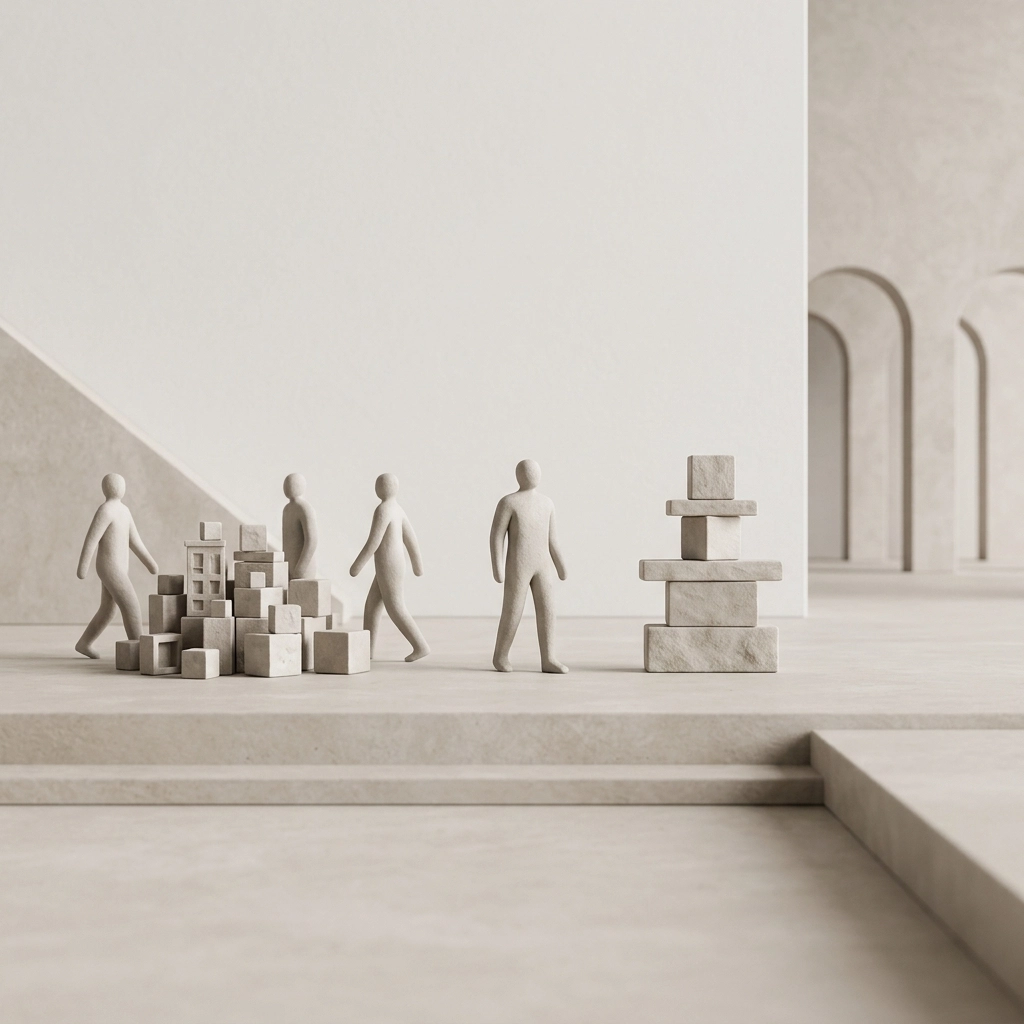
This is invisible labor, and it is governed by an identity that believes if you stop holding it together, everything will collapse. This belief creates a "C.A.G.E. loop": a cycle of over-functioning that prevents others from developing their own agency, which in turn reinforces your need to over-function. You are trapped by the very stability you worked so hard to create.
The Identity Dissonance of Mid-Life
The frustration you feel is a form of identity dissonance. There is a gap between who you are becoming and the role you are still performing. You are ready for sovereign authorship: the ability to direct your own life based on internal authority: but you are still stuck in the maintenance phase of a life you’ve already built.
This is often where the "mid-life crisis" framing fails high-capacity women. This isn't a desire to blow up your life; it is a desire to inhabit it. It is the recognition that you have become a ghost in your own machine. You have optimized for everyone else’s ease while your own vitality has been assigned to system maintenance.
The transition from Stabilizer to Sovereign requires a recalibration of your identity architecture. It requires moving from being "required" to being "self-led." This shift is often met with internal resistance because the Stabilizer identity provides a sense of safety and worth. To stop managing everything feels like an abdication of duty, or worse, a risk to the relational harmony you’ve spent decades perfecting.
Correcting the Capacity Assignment Error
To move beyond the Mid-Life Miscalculation, you must address the structural mismatches in your life. This is not about better time management or a more efficient planner. It is about a fundamental shift in internal governance.
- Acknowledge Responsibility Asymmetry: Recognize where you have taken on the cognitive and emotional labor that belongs to others. This is the first step in dismantling over-functioning.
- Audit Your Invisible Labor Architecture™: List the things you do that no one else notices but everyone relies on. Determine which of these are truly yours to carry and which are survival adaptations from an earlier season.
- Confront the Illusion of Alignment: Sometimes, the reason you keep managing everything is that you’ve built a life that only works if you are at the helm. This is an illusion of alignment. True alignment means the systems you build can operate without your constant intervention, allowing you to move into higher levels of leadership and self-expression.
- Identify the Cost of Being the Stabilizer: The cost is your sovereignty. Every hour spent managing a detail that someone else is capable of managing is an hour stolen from your own creative or intellectual expansion.

From Managing to Authoring
The goal of mid-life is not to stop working; it is to stop working for the sake of mere stabilization. It is about moving into a phase of durable presence, where your authority is no longer derived from your utility, but from your identity.
When you shift from the Stabilizer pattern to Sovereign Authorship, the nature of your "hard work" changes. You move from the exhausting labor of keeping plates spinning to the deep, meaningful work of directing your life’s energy toward what actually matters to you. You stop being the operating system for everyone else and start being the author of your own experience.
This shift requires a willingness to let the plates wobble. It requires a tolerance for the temporary discomfort that occurs when you stop over-functioning and allow others to pick up their own weight. It is the only way to reclaim the agency you need to finally enjoy the life you have built.
Defining the Next Season
If you find yourself in the Mid-Life Miscalculation, know that the path forward is not more effort. The "more effort" strategy is what got you here. The path forward is a structural redesign of how you relate to responsibility and identity.
You have spent years being the strong one, the reliable one, the one who holds it all together. You have proven you can do it. Now, the question is no longer "Can you?" but "Should you?"
Your capacity is a resource, not a mandate. It is time to stop assigning it to the maintenance of the status quo and start assigning it to the creation of your own sovereignty.

The first step in this recalibration is understanding exactly how the Stabilizer pattern is showing up in your current reality. Are you over-functioning in your relationships? Are you the invisible architect of your office’s culture at the expense of your own strategic goals?
Identifying these patterns is the baseline for any meaningful change. Without a diagnostic understanding of your current internal governance, you will simply continue to replicate the same patterns in new environments.
Take the next step in reclaiming your agency. Complete the Stabilizer Assessment at hersovereignos.com/assessment to see where your identity architecture is keeping you stuck in maintenance mode: and how to finally begin authoring the ease you were promised.