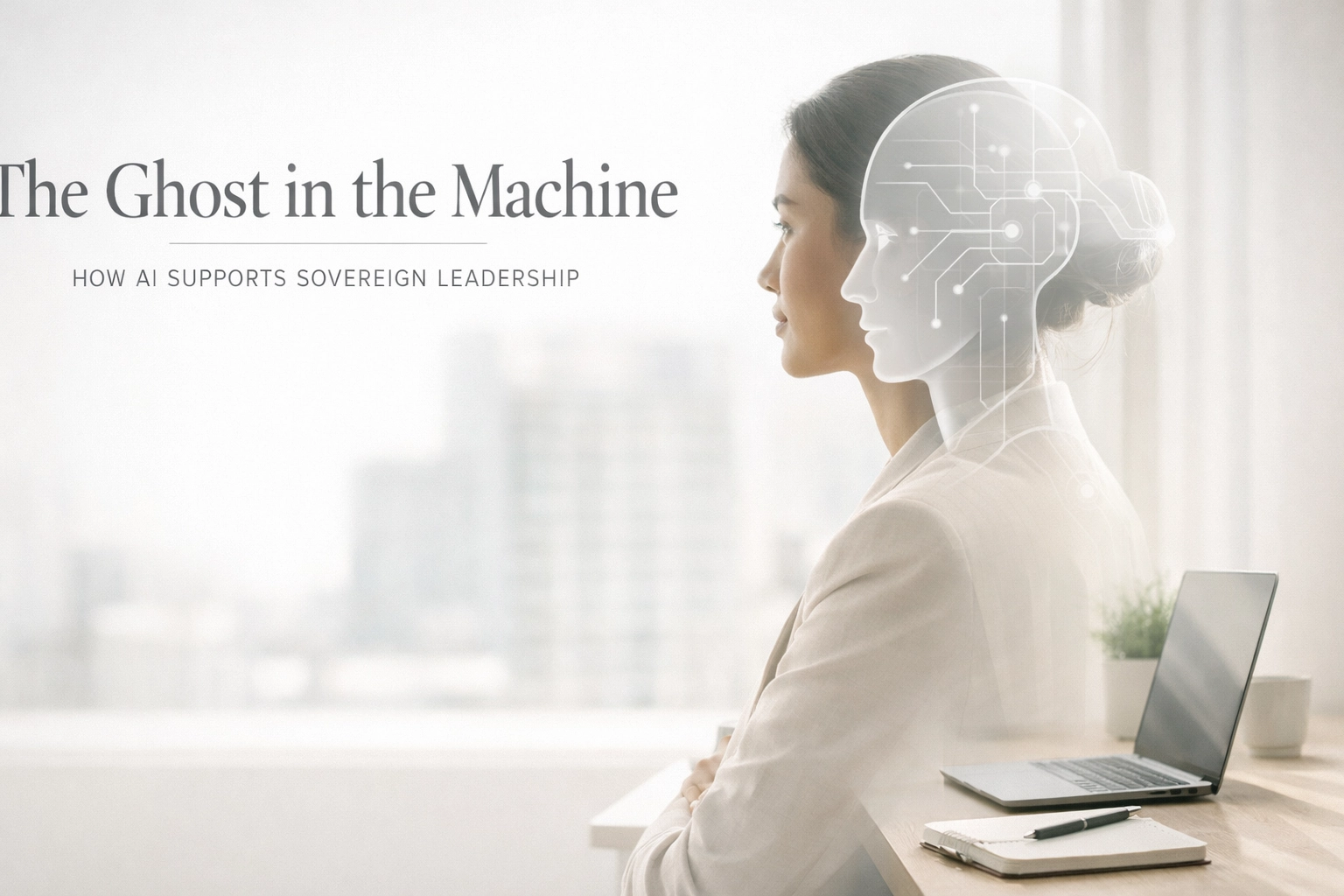
The Ghost in the Machine: How AI Supports Sovereign Leadership
Sovereignty is the state of total internal authority over one’s direction, identity, and output. In the traditional leadership model, the leader is the engine, the fuel, and the navigator simultaneously. This centralization of functions creates a structural bottleneck that eventually leads to systemic collapse. As capacity increases, the human element becomes the primary point of friction.
Artificial Intelligence is not a tool for marginal efficiency. It is a structural layer that allows for the decoupling of Identity Authority from Creation Authority. When integrated correctly, AI functions as the "Ghost in the Machine": an invisible infrastructure that maintains the momentum of the organization while the leader remains the sole source of intent. This is the architecture of the future-focused sovereign leader.
The Bifurcation of Authority: Identity vs. Creation
The fundamental error in modern leadership is the failure to distinguish between Identity Authority and Creation Authority. Most leaders believe they must be the primary creator to maintain the integrity of their vision. This is a misunderstanding of power.
Identity Authority is the "Who" and the "Why." It is the non-negotiable essence of the brand, the strategy, and the ethos. This authority is non-transferable. If you outsource your Identity Authority: whether to a consultant, a team member, or an algorithm: you have abdicated your sovereignty. You are no longer the leader; you are a passenger in a vehicle you no longer own.
Creation Authority is the "What" and the "How." It is the generation of artifacts, the execution of tasks, and the maintenance of operational flows. Creation is mechanical. It is the process of translating intent into reality. While creation requires precision, it does not require a soul. This is where the human leader currently wastes 90% of their cognitive bandwidth.

AI as the Infrastructure of Creation Authority
A sovereign operating system requires a layer of execution that does not depend on human willpower. AI provides the substrate for this layer. It is the "Ghost" that inhabits the machine of your business, executing your intent with clinical consistency.
The integration of AI into your leadership architecture is not about replacing your team. It is about replacing the need for you to be the constant catalyst for action. When the infrastructure is built correctly, the machine operates on your established protocols without requiring your active participation in the minutiae. This is not automation; it is the structural externalization of your Creation Authority.
By offloading the "How" to an AI-driven system, the leader is freed from the burden of production. You are no longer required to be the most productive person in the room. You are required to be the most clear. Clarity is the only currency that matters in a sovereign system.
The Architecture of Decision: Defeating Cognitive Fatigue
Decision fatigue is a structural deficit, not a character flaw. Every micro-decision made regarding execution leeches energy away from the decisions regarding direction. A leader who spends their day deciding on email copy, social media formatting, or data sorting is a leader who has compromised their capacity for high-level sovereignty.
AI serves as a filter within your Decision Architecture. It functions by applying your pre-defined protocols to incoming data.
- Protocol Definition: You establish the rules of engagement (Identity).
- AI Processing: The system applies these rules to the work (Creation).
- Sovereign Review: You provide the final stamp of approval, ensuring alignment.
This workflow reduces the leader’s role to that of the Architect and the Auditor. You design the system, and you verify the output. You do not labor in the middle. This structure creates a "low-friction" environment where the business can scale without increasing the leader’s stress levels. The machine handles the volume; the leader handles the value.

Building for Time Freedom: The Sovereign Outcome
Time freedom is the measurable output of an integrated sovereign system. It is not an accident or a luxury; it is the result of a deliberate structural choice. If your presence is required for the daily operation of your creation, you do not own a system; you own a high-level job.
The "Ghost in the Machine" approach allows the leader to step back into the role of the Observer. When the Creation Authority is successfully transitioned to AI-backed infrastructure, time is no longer tied to output. You move from a linear relationship with productivity to an exponential one.
This freedom allows for the cultivation of "Deep Capacity." It provides the space necessary to observe market shifts, refine the core philosophy of the business, and engage in high-level relational governance. A sovereign leader who is not trapped in the production cycle is a leader who can see the future before it arrives.
The Preservation of the Human Core
There is a common fear that the introduction of AI will dilute the "human touch" of a brand. This fear is rooted in a misunderstanding of where the human touch resides. The human touch is not in the typing of the words or the organizing of the spreadsheet; it is in the original spark of intent and the final evaluation of quality.
By utilizing AI to hold the Creation Authority, you actually preserve the human core. You prevent the burnout and resentment that occurs when a high-capacity individual is forced to perform repetitive, low-level tasks. You allow the human element to remain at the highest level of the hierarchy, where it is most effective.
The machine does not have an ego. It does not have off-days. It does not require validation. It simply executes. This allows the leader to maintain a professional distance from the mechanical aspects of the business, ensuring that their energy is reserved for the aspects of the work that truly require a sovereign consciousness.

Implementation: Transitioning to a Sovereign System
Transitioning to this model requires a ruthless audit of your current activities. You must identify every area where you are currently acting as the "Creation Authority" and develop a protocol to externalize that function.
- Audit the Friction: Identify tasks that feel "heavy" or repetitive.
- Codify the Intent: Write down the exact logic you use to complete those tasks.
- Build the Ghost: Use AI tools to mirror that logic and automate the execution.
- Maintain the Identity: Ensure that you remain the final arbiter of all output.
This is not a project that is completed in a week. It is an ongoing architectural refinement. As AI capabilities evolve, the amount of Creation Authority you can offload increases. The goal is to reach a state where your only involvement in the business is the exercise of your Identity Authority and the enjoyment of the results.
The Future of High-Capacity Leadership
The era of the "hustling" leader is ending. It is being replaced by the era of the Sovereign Architect. The most successful individuals in the coming decade will not be those who work the hardest, but those who build the most robust systems.
AI is the essential component of these systems. It provides the scale and consistency that human effort cannot match. By embracing the "Ghost in the Machine," you are not losing control; you are gaining a level of sovereignty that was previously impossible. You are building a structure that can support your vision without consuming your life.
This is the standard for the Melissa McCrery framework. We do not build jobs. We build sovereign operating systems. AI is the engine that makes those systems durable, scalable, and( most importantly( freeing.))