
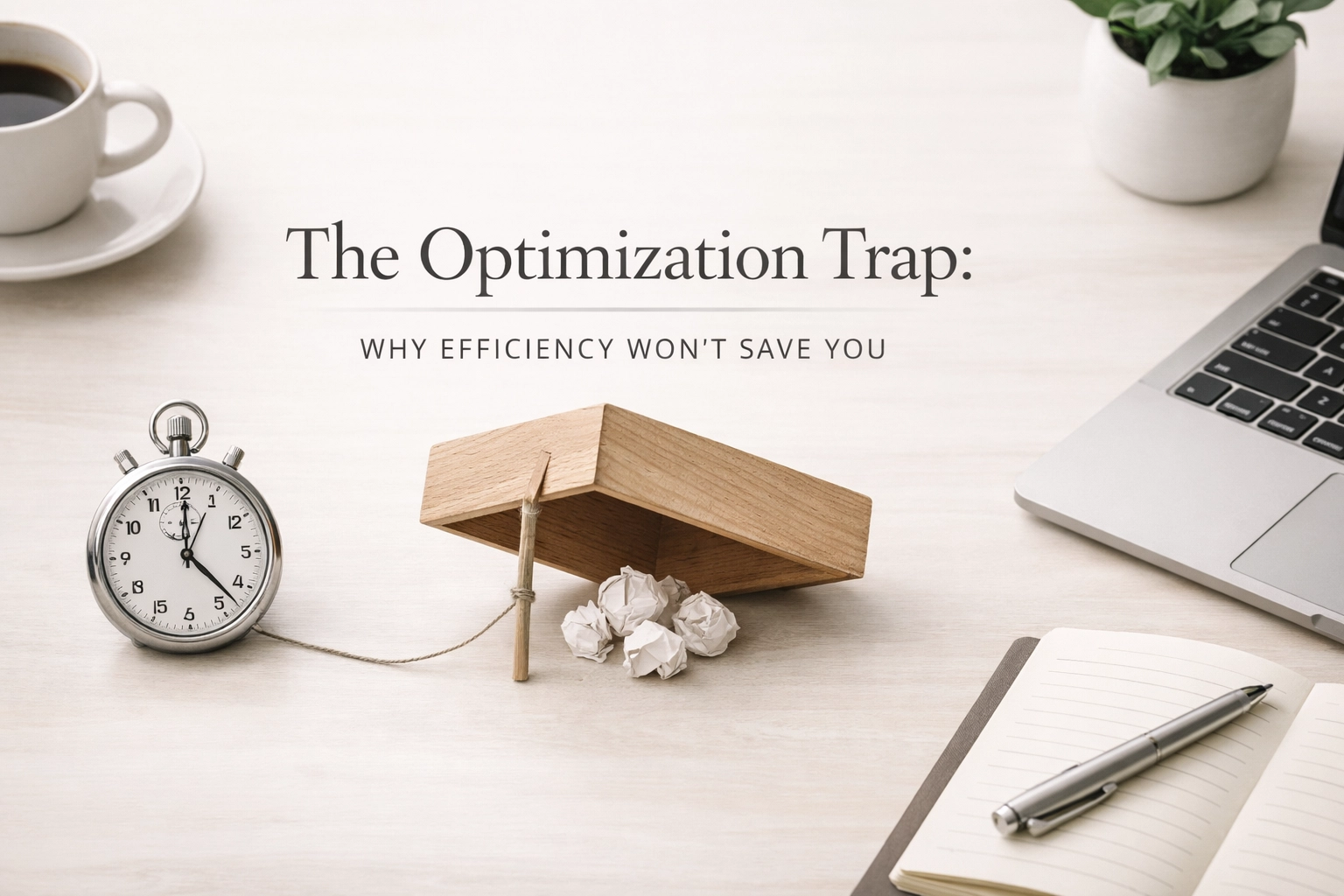
The Optimization Trap: Why Efficiency Won’t Save You
Efficiency is not a measure of success. It is a measure of speed. In the context of high-level leadership and personal architecture, efficiency often functions as a sophisticated camouflage for a lack of structural identity. You are likely capable of executing tasks at a higher velocity than those around you. This capacity is a baseline reality, yet it frequently leads to a specific form of systemic failure: the optimization trap.
The optimization trap occurs when you prioritize the refinement of execution before you have established the integrity of the environment. You are perfecting the wrong movements. You are streamlining processes that should not exist. You are becoming increasingly proficient at maintaining a life and a business that do not actually support your sovereignty.
This is not a failure of effort. It is a failure of architecture.
The Fallacy of More Efficient Friction
Optimization is a secondary function, not a primary objective. It is the process of making a functional system more fluid. However, when the underlying system is structurally unsound, optimization merely accelerates the rate of friction. It makes the wrong things happen faster.
For the high-capacity woman, the drive toward efficiency is often a response to internal noise. When the internal environment feels chaotic or the external demands feel overwhelming, the reflexive response is to "tighten up" the schedule, implement new productivity hacks, or delegate more aggressively. These are tactical responses to a structural problem. You are attempting to solve a deficit in identity through a surplus of activity.
High-capacity individuals possess the unique ability to make dysfunctional systems look functional through sheer force of will. You have spent years compensating for broken internal architecture with high-speed execution. This is the competence trap. You have become so excellent at managing fragmentation that you have lost the ability to recognize it as a problem.

Optimization as a Mask for Structural Deficit
Efficiency cannot replace clarity. If you do not know who you are in the context of your work and life, no amount of time-blocking will save you. Most productivity frameworks are designed for those who lack the discipline to act. They are not designed for the woman who is already acting but finds herself exhausted by the weight of her own momentum.
The obsession with efficiency masks a fundamental lack of structural identity. Structural identity is the core logic that dictates what enters your field and what remains outside of it. Without this identity, your life becomes a collection of external demands that you have simply learned to process very quickly.
This is not about working harder. It is about recognizing that your current architecture was built to handle a version of you that no longer exists. You are trying to run a high-definition soul on a standard-definition operating system. The "glitches" you experience: burnout, resentment, the feeling of being "on" but never present: are not signs that you need to be more efficient. They are signs that your system has reached its capacity for compensation.
The Exploration Deficit: Rushing to Execution
Organizational research indicates that most systems allocate only 5-10% of their timeline to exploration and 90% to execution. This inversion of priority is a hallmark of the optimization trap. When exploration is bypassed, execution becomes a series of corrections. You spend your days fixing problems that were created by premature optimization.
To build a sovereign life, the exploration phase: the phase of understanding your internal environment and actual constraints: must occupy a significant portion of your energy. You cannot optimize what you do not understand. If you rush to execution, you are essentially guessing. You are building a high-speed engine without a steering mechanism.
When a capable leader underperforms, it is rarely due to a lack of effort. It is usually because they have been told to "figure it out faster" before they have identified the true nature of the challenge. This creates a cycle where metrics are met, but progress is not made. You are hitting your KPIs while your internal structure is eroding.

Hidden Constraints and False Solutions
Optimization requires an explicit understanding of constraints. However, most high-capacity women operate under a series of unrecognized, internal constraints that create "false solutions." You assume that certain burdens are mandatory. You assume that your availability must be absolute. You assume that your value is tied to your output.
These unstated assumptions function as invisible boundaries. They prevent you from reaching an actual optimal solution because you are only looking for answers within the cage of your current expectations. You find a "solution" that works within the context of your exhaustion, and you call it efficiency. It is not efficiency; it is survival.
To escape the trap, you must explicitly challenge the assumptions that define your scope. This is the difference between rearranging the furniture and redesigning the room. Optimization is rearranging. Sovereignty is redesigning.
The HER Sovereign OS: A Structural Alternative
This is not a call for more coaching or a new set of "mindset shifts." This is about infrastructure. The HER Sovereign OS is a structural framework designed to replace the optimization trap with a coherent architecture of authority.
The framework is built on the premise that execution must emerge from identity, not the other way around. It recognizes that you do not need more tools for doing; you need a more robust system for being. When the internal architecture is sound, efficiency becomes a natural byproduct, not a desperate pursuit.
1. Identity as Infrastructure
In a sovereign system, your identity is the primary constraint. It dictates the logic of your business and the boundaries of your personal life. You do not optimize for the sake of more; you optimize for the sake of coherence. If an activity does not align with the structural identity of the system, it is removed, not improved.
2. Decision Architecture
The optimization trap thrives on decision fatigue. When you have to decide everything in real-time, you default to the path of least resistance: which is usually "do more, faster." A sovereign operating system builds protocols for clarity. It removes the need for constant micro-decisions by establishing high-level authority layers.
3. Relational Governance
Efficiency often breaks down in the relational sphere. High-capacity women often "over-function" to compensate for the lack of structure in their teams or families. Sovereign OS establishes relational integrity through clear governance. It moves from fusion (where your energy is entangled with everyone else’s) to sovereignty (where everyone is responsible for their own internal authority).

The Cost of the Competence Trap
The danger of being highly competent is that you can succeed at things that do not matter to you. You can build a highly efficient life that feels entirely hollow. This is the ultimate cost of the optimization trap. You become excellent at a narrow set of moves while losing the capacity to explore the unexpected.
When you are trapped in optimization, you lose your peripheral vision. You are so focused on the dashboard: the metrics, the schedule, the efficiency of the machine: that you forget to look out the window. You are traveling at 100 miles per hour toward a destination you never actually chose.
This is why efficiency won't save you. Efficiency is a tool for the journey, but it is not the compass. If you are headed in the wrong direction, being efficient only ensures that you will end up further from where you belong.
Establishing Structural Coherence
The shift from optimization to sovereignty requires a period of deliberate deceleration. You must stop the machine long enough to inspect the gears. This is not a "sabbatical" or a "break." It is an audit of your internal architecture.
You must differentiate between what is productive and what is merely active. Activity is noise. Productivity, in its truest sense, is the movement of a system toward its intended purpose. If the purpose is missing, the activity is meaningless.
You carry high internal capacity. This is an objective fact. The question is no longer how much you can do, but what you are building. Are you building a monument to efficiency, or are you building an architecture for sovereignty?

Beyond the Trap
We are not looking for a better way to do the wrong things. We are looking for a structural correction that makes "doing" a byproduct of a well-ordered life. This is the work of HER Sovereign OS.
It is a system for the woman who has realized that her capacity is her greatest asset and her greatest liability. It is for the leader who is tired of being the engine for everyone else's lack of structure. It is for those who are ready to stop optimizing a broken architecture and start building a sovereign one.
The optimization trap ends when you realize that you cannot solve an architectural problem with an execution solution. You do not need to be faster. You need to be more coherent.
Efficiency is the final step in a long process of structural alignment. When you start there, you fail. When you end there, you are sovereign.