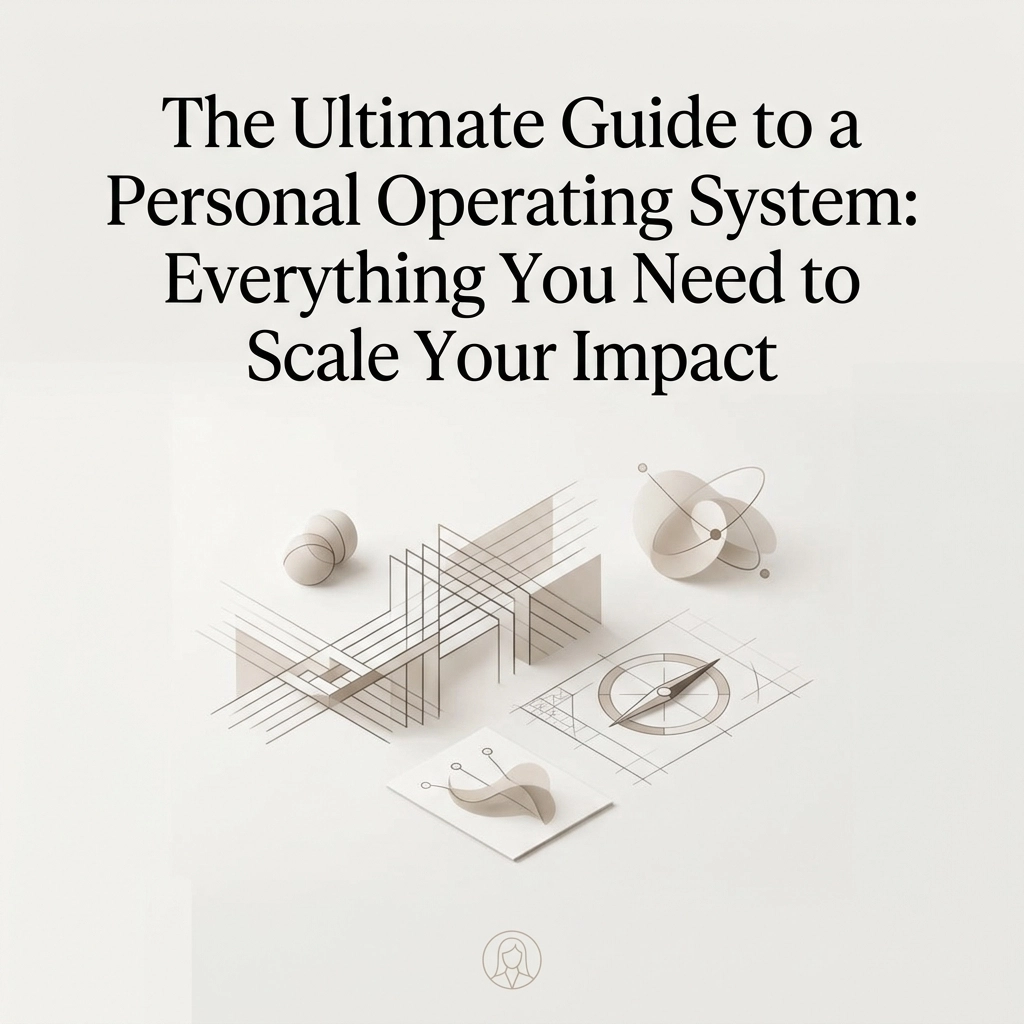
The Ultimate Guide to a Personal Operating System: Everything You Need to Scale Your Impact
For the high-capacity woman, the primary constraint on impact is rarely a lack of skill or effort. It is a structural mismatch. Most successful women reach a threshold where their internal complexity, the depth of their thought, the weight of their responsibilities, and the scale of their vision, exceeds the capacity of their external architecture. When this gap widens, the result is not just fatigue; it is a profound sense of identity dissonance.
You have likely outgrown standard productivity models. The checklists, time-blocking techniques, and life hacks that fueled your ascent now feel like restrictive scaffolding. They manage your tasks, but they do not govern your life. Scaling your impact requires a shift from fragmented management to integrated governance. This is the role of a personal operating system.
The Architecture of Internal Complexity
Your current exhaustion is likely a symptom of being the "stabilizer." In many professional and personal systems, the high-capacity woman functions as the unacknowledged glue that holds disparate parts together. This is what we define as the Cost of Being the Stabilizer™. You have built environments, families, teams, and organizations, that run efficiently because you are constantly compensating for their structural gaps.
This is not a failure of character; it is a capacity assignment error. You are using your vital energy to maintain basic operations rather than utilizing a leadership operating system to automate that maintenance. When your system relies on your presence to function, you are not a leader of an architecture; you are a component within a machine.
A true personal operating system (POS) is the durable, self-led framework that allows you to move from being "required" to being "sovereign." It is the invisible backbone that ensures your decisions align with your internal authority, regardless of external pressure.
From Fragmented Management to Integrated Governance
Most life management systems are reactive. They are designed to help you respond to the "invisible load", the constant stream of demands that characterize high-level leadership. However, managing the load is not the same as governing the self.
Governance is a proactive, structural stance. It is the process of setting the rules of engagement for your life and work before the demands arrive. This requires a transition from a "personality-driven" model, where your daily output depends on your mood, willpower, or the urgency of others, to a system-led model.

This architectural shift allows you to address the invisible load architecture™ with clinical precision. Instead of negotiating with every new request, your system provides a pre-determined "yes" or "no" based on your established identity architecture. You are no longer deciding in the moment; you are executing a sovereign strategy.
The Three Authority Layers of HER Sovereign OS
A robust life operating system must be layered. It cannot simply be a digital tool or a paper planner. It must be an integrated stack that moves from the abstract to the concrete, ensuring that every action you take is an expression of your internal authority.
1. Identity Authority: The Layer of Internal Governance
This is the foundational layer. It is not about what you do, but who is authoring the doing. For many women, their identity has been shaped by the C.A.G.E. loop: a cycle of compliance, achievement, guilt, and exhaustion. Identity Authority is the process of reclaiming agency and moving from a role-based identity to an essence-based identity.
In this layer, you define the core principles that govern your capacity. You stop over-functioning as a survival adaptation and begin to operate from a place of sovereign self-leadership.
2. Ingenuity Authority: The Layer of Leadership and Commitments
Once the identity layer is secure, you can address how you interact with the world. Ingenuity Authority is where you design your leadership frameworks. It involves the strategic assignment of your capacity.
This layer governs your "Relational Governance™." It is where you decide how you will lead others without becoming their stabilizer. You move away from Responsibility Asymmetry™: where you care more about an outcome than the person actually responsible for it: and toward a model of collaborative, sovereign contribution.
3. Creation Authority: The Layer of Execution and Movement
This is the most visible layer, often mistaken for the entire system. It includes the workflows, tools, and routines that move projects forward. However, in a personal operating system, execution is the final step, not the first.
Creation Authority ensures that your movement is coherent. Without the previous layers, execution is merely "hustle." With them, execution becomes the precise application of force to achieve a specific, sovereign outcome.
The Illusion of Alignment
A significant risk in building a life operating system is the "illusion of alignment." This occurs when your system appears to be working because you are hitting your targets and maintaining your schedule, yet you still feel a persistent sense of emptiness or misalignment.
The system is driving the choice, rather than your internal authority. You have simply traded one master (the demands of others) for another (the demands of your productivity app). A sovereign system must be a reflection of your identity based leadership. It must be designed to amplify your essence, not just your output.

If you find yourself perfectly executing a plan that leaves you feeling more like a machine and less like a person, you have likely outsourced your authority to the system itself. This is why HER Sovereign OS is a durable, self-led system. It is designed to be a tool for the sovereign self, not a replacement for her.
Scaling Impact Through Durable Systems
Scaling your impact is not about doing more. It is about increasing the leverage of your presence. This is only possible when you have a system that handles the "invisible governance" of your life.
When your personal operating system is functioning correctly, you experience several key shifts:
- Reduced Decision Fatigue: Decisions are made at the architectural level, not the tactical level.
- Increased Presence: Because the "maintenance" of your life is automated, you can be fully present in your zone of genius.
- Transferable Stability: You move from being the stabilizer of the system to being the architect of systems that stabilize themselves.
This is the path to reclaiming agency. It is the recognition that your capacity is a finite, sacred resource that must be governed, not just managed.
Building Your Identity Architecture
The transition to a sovereign POS is not an overnight event. It is a process of deconstruction and rebuilding. You must first identify the survival adaptations: like over-functioning and the stabilizer pattern: that have served you in the past but are now limiting your future.
As you build your identity architecture, you will likely encounter identity grief. This is the discomfort of letting go of the version of yourself that was "required" by everyone else. However, on the other side of that grief is a level of impact and personal peace that is unattainable through traditional productivity models.
Your personal operating system is the infrastructure for your next decade of impact. It is the container that allows your internal complexity to finally be matched by external clarity.
If you are ready to move beyond fragmented management and into sovereign self-leadership, it is time to stop managing your life and start governing it. The impact you are meant to make requires nothing less than a completely integrated, identity-first architecture.
Scaling your impact is not a matter of working harder; it is a matter of building better. Begin by establishing your internal authority, and let the rest of the system emerge from that sovereign source.